

Mounting a sonar keeps readings steady while you drift or troll slowly.
These mounts and sonars work best.
The Outdoor Recreation is reader-supported. As an Amazon Associate we earn from qualifying purchases, at no extra cost to you.
Quick Picks
- Best kayak track: Fish Finder Track Mount with Transducer Arm
- Best suction: FishPod 5X and HawkEye FishTrax Combo
- Best RC boat: RC Boat Sonar Mount Arm (Deeper Compatible)
- Best mountable sonar: HawkEye FishPod 5X Bluetooth Fish Finder
- Best permanent unit: Humminbird PiranhaMAX 4 DI
Comparison Table
| Product | Best for | Key spec | Standout feature | |
|---|---|---|---|---|
| Fish Finder Track Mount with Transducer Arm | Best kayak track | Display + transducer mount | 360-degree adjust | View |
| FishPod 5X and HawkEye FishTrax Combo | Best suction | Sonar + suction mount | Kayak and boat ready | View |
| RC Boat Sonar Mount Arm (Deeper Compatible) | Best RC boat | Modular arm | No-drill attach | View |
| HawkEye FishPod 5X Bluetooth Fish Finder | Best mountable sonar | AI fish targeting | 4 preset modes | View |
| Humminbird PiranhaMAX 4 DI | Best permanent unit | 4.3 in color screen | Down Imaging | View |
Detailed Reviews

1. Fish Finder Track Mount with Transducer Arm
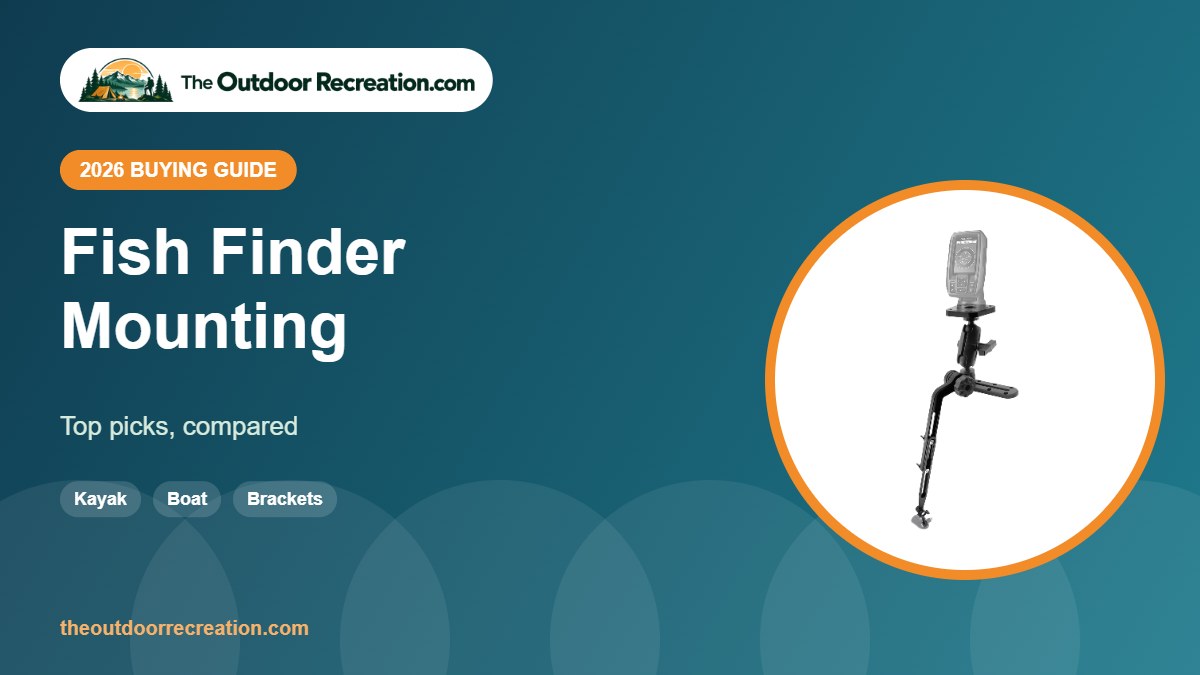
1This track mount holds a fish finder display and a transducer arm together on one setup for kayaks and SUPs.
Ball sockets let you angle the screen and arm, keeping the deck tidy for kayak anglers who mount sonar.
Pros & Cons
What we like
- Two mounts in one
- Fully adjustable
- Clean deck setup
Watch out for
- Needs a gear track
- Check fit for your unit
Key Specs
- Fits: kayak and SUP tracks
- Adjust: 360-degree ball sockets
- Holds: display and transducer

2This combo pairs the HawkEye FishPod 5X Bluetooth sonar with a FishTrax suction cup mount.
The mount attaches a fish finder to kayaks or boats, so you can switch between casting and fixed mounting.
Pros & Cons
What we like
- Sonar plus mount
- Flexible use
- Smart preset modes
Watch out for
- App-dependent
- Suction mounts need clean surfaces
Key Specs
- Sonar: FishPod 5X
- Mount: suction cup
- Use: kayak, boat

3This modular mount arm holds a castable smart sonar such as a Deeper on the deck of an RC bait boat.
It attaches with hook-and-loop without drilling and packs flat, useful for anglers who scout swims with a bait boat.
Pros & Cons
What we like
- No drilling
- Packs flat
- Fits Deeper sonars
Watch out for
- Niche use
- Check boat size
Key Specs
- Fits: Deeper Pro and Pro+
- Attach: hook-and-loop
- Use: RC bait boats

4. HawkEye FishPod 5X Bluetooth Fish Finder
4The HawkEye FishPod 5X is a Bluetooth sonar with four preset modes that auto-adjust settings to target fish by size, depth or schools.
FishEcho tunes out clutter and BottomScan helps tell weeds from bottom, while the TraxNut mount fits any 1/4-20 bracket on kayaks and boats.
Pros & Cons
What we like
- Smart preset modes
- Mounts or casts
- Clutter filtering
Watch out for
- App-dependent
- Smaller brand ecosystem
Key Specs
- Connection: Bluetooth
- Mount: TraxNut 1/4-20
- Features: FishEcho, BottomScan

5The Humminbird PiranhaMAX 4 DI is a classic boat-mounted fish finder with dual-beam sonar and Down Imaging on a 4.3-inch color screen.
It is not castable, but it is a good upgrade when you move from shore fishing to a small boat or kayak with a mounted transducer.
Pros & Cons
What we like
- Down Imaging detail
- Dual-beam sonar
- Easy interface
Watch out for
- Needs a mounted transducer
- Not castable
Key Specs
- Screen: 4.3 in color
- Sonar: dual beam + Down Imaging
- Use: boat or kayak
How We Chose
We compared sonar range, depth, connection type, mapping, battery life and ease of use across dozens of castable and portable fish finders and their accessories, then read verified owner feedback to find reliability issues that spec sheets miss. We did not receive free products, and we do not claim hands-on testing. TOR Scores combine published specs, verified owner feedback and overall value. For a closer look, see our guide to the best castable fish finder ( ).
Using Sonar From a Kayak
On a kayak, you can cast the sonar, tow it behind on a short tether or mount it with a bracket. A track mount or suction mount keeps it steady, and a phone mount keeps the screen in view. Keep paddles and lines clear of the tether, and anchor over structure once you find fish.
Setup Tips for Better Readings
Charge the sonar fully, update the app and pair it before you leave home. Turn on Wi-Fi or Bluetooth on your phone, keep the phone within range and use a phone mount if you fish from a kayak. Start in a simple 2-D sonar mode, then switch to mapping or ice modes once you are comfortable. We cover this in more depth in our roundup of the best castable fish finder you can buy.
Care and Maintenance
Rinse the sonar with fresh water after each trip, especially in saltwater, and dry it before charging. Check the tow point and charging contacts for corrosion, store it in a padded case and replace worn line before it breaks. Keep firmware and the app updated for the best performance.
What Is a Castable Fish Finder?
A castable fish finder is a small floating sonar that you tie to your line, cast out and reel back. It sends sonar readings to your phone, tablet or a handheld screen, showing depth, bottom shape, weeds and fish. Because it needs no mounted transducer, it works from shore, docks, kayaks, rental boats and the ice. You may also find our guide to the best castable fish finder camera ( ) helpful.
How to Choose a Castable Fish Finder
- Connection: Wi-Fi models usually reach farther than Bluetooth; radio models send data to their own handheld screen.
- GPS mapping: built-in GPS lets you map the bottom as you reel in.
- Depth range: most read from about 135 to 260 feet; check the listed maximum.
- Display: phone apps show more detail; handheld screens avoid draining your phone.
- Battery: look for several hours of run time and easy charging.
- Ice mode: a flasher view helps ice anglers watch fish react to a jig.
How to Read Your Fish Finder Screen
The bottom appears as a solid line or band; a hard bottom shows as a thick, bright return and soft mud as a thinner one. Weeds look like vertical lines rising from the bottom. Fish usually appear as arches or icons. Water temperature and depth help you decide where fish are likely to hold during the season.
How to Cast and Tether a Sonar
Tie the sonar to strong braided line with a reliable knot, such as a Palomar or improved clinch, and use a snap or swivel on the tow point. Use a rod rated for the sonar’s weight and make smooth, side-arm casts rather than hard overhead snaps. Reel in slowly and steadily so the sonar stays level and the readings stay clean. Related: our shortlist of the best castable fish finder reviews.
Batteries and Charging
Most castable sonars use built-in rechargeable batteries that last several hours. Bring a power bank for long days and keep your phone charged too, since it is your screen. Mounted fish finders run from 12V batteries; lithium LiFePO4 batteries are lighter and last longer than sealed lead-acid batteries.
Related guides: best castable fish finder mounted, best castable fish finder mounts, best castable fish finder bracket. See every pick in our Fish Finders category.
Sources and further reading: NOAA Fisheries: recreational fishing resources and Leave No Trace: the 7 Principles. Product specs come from brand listings on Amazon. Always check local fishing regulations before you fish.
Frequently Asked Questions
How does a castable fish finder work?
It floats on the surface and sends sonar pulses down, then streams depth, bottom and fish readings to your phone or a handheld screen.
Can I use it in saltwater?
Many can, but rinse it in fresh water after every trip to prevent corrosion.
How long does the battery last?
Usually several hours per charge; carry a power bank for long trips.
Do I need a phone to use one?
Most castable sonars use a phone or tablet app; some budget models include a handheld display instead.
How far can you cast a castable fish finder?
As far as your rod and line allow, but the wireless link has its own range limit, often around 150 to 330 feet depending on the model.
Final Verdict
Kayak anglers should use a track mount; the FishPod 5X mounts easily.



Write Your Review
No reviews yet. Be the first to share your experience!