

Reading the ground under the water tells you where fish feed and hide.
These sonars show bottom detail best.
The Outdoor Recreation is reader-supported. As an Amazon Associate we earn from qualifying purchases, at no extra cost to you.
Quick Picks
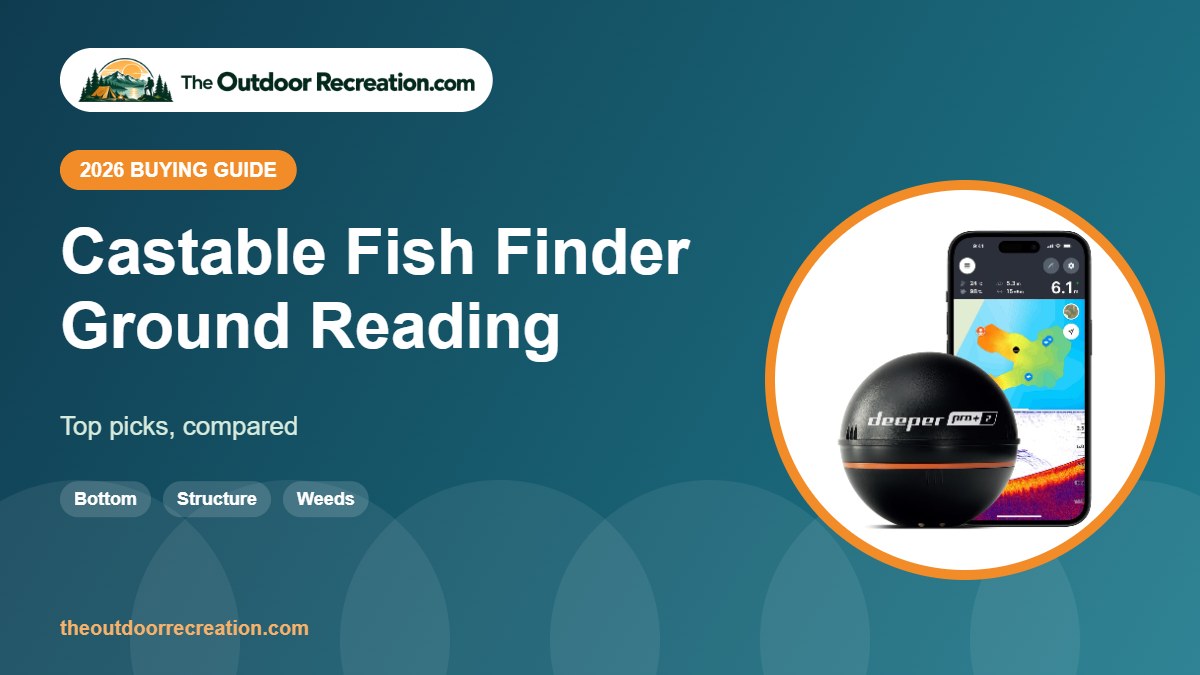
- Best bottom detail: Deeper PRO+ 2 Smart Sonar
- Best contour maps: Garmin Striker Cast GPS
- Best BottomScan: HawkEye FishPod 5X Bluetooth Fish Finder
- Best Down Imaging: Humminbird PiranhaMAX 4 DI
- Best value: Garmin Striker Cast
Comparison Table
| Product | Best for | Key spec | Standout feature | |
|---|---|---|---|---|
| Deeper PRO+ 2 Smart Sonar | Best bottom detail | Built-in GPS + Wi-Fi | Onshore bathymetric mapping | View |
| Garmin Striker Cast GPS | Best contour maps | Built-in GPS | Quickdraw Contours maps | View |
| HawkEye FishPod 5X Bluetooth Fish Finder | Best BottomScan | AI fish targeting | 4 preset modes | View |
| Humminbird PiranhaMAX 4 DI | Best Down Imaging | 4.3 in color screen | Down Imaging | View |
| Garmin Striker Cast | Best value | Streams up to 200 ft | 2-D and flasher modes | View |
Detailed Reviews

1The Deeper PRO+ 2 is a castable smart sonar with built-in GPS and Wi-Fi, so it maps the bottom as you reel in, even from shore.
It connects to the Deeper app on your phone and is a favorite of bank anglers, kayakers and ice anglers who want maps and sonar in one small ball.
Pros & Cons
What we like
- GPS mapping from shore
- Wi-Fi link for long range
- Works year-round including ice
Watch out for
- Premium price
- App features take time to learn
Key Specs
- Connection: Wi-Fi
- GPS: built in
- Use: shore, kayak, boat, ice

2The Garmin Striker Cast GPS adds built-in GPS, so you can make your own fishing maps with 1-foot contours using Quickdraw Contours while you cast and reel.
It streams sonar to your phone like the standard model, but the mapping makes it the stronger pick for anglers who want to learn a lake’s structure.
Pros & Cons
What we like
- Builds custom contour maps
- Mark spots precisely
- Same easy app as Striker Cast
Watch out for
- Costs more than the non-GPS model
- Mapping needs many casts
Key Specs
- GPS: built in
- Mapping: Quickdraw Contours, 1 ft
- Display: phone or tablet

3The HawkEye FishPod 5X is a Bluetooth sonar with four preset modes that auto-adjust settings to target fish by size, depth or schools.
FishEcho tunes out clutter and BottomScan helps tell weeds from bottom, while the TraxNut mount fits any 1/4-20 bracket on kayaks and boats.
Pros & Cons
What we like
- Smart preset modes
- Mounts or casts
- Clutter filtering
Watch out for
- App-dependent
- Smaller brand ecosystem
Key Specs
- Connection: Bluetooth
- Mount: TraxNut 1/4-20
- Features: FishEcho, BottomScan

4The Humminbird PiranhaMAX 4 DI is a classic boat-mounted fish finder with dual-beam sonar and Down Imaging on a 4.3-inch color screen.
It is not castable, but it is a good upgrade when you move from shore fishing to a small boat or kayak with a mounted transducer.
Pros & Cons
What we like
- Down Imaging detail
- Dual-beam sonar
- Easy interface
Watch out for
- Needs a mounted transducer
- Not castable
Key Specs
- Screen: 4.3 in color
- Sonar: dual beam + Down Imaging
- Use: boat or kayak

5The Garmin Striker Cast is a rugged castable sonar that streams 2-D sonar and an ice-fishing flasher view to your phone or tablet through the free STRIKER Cast app.
Setup takes minutes: download the app, pair the sonar and cast. It suits shore, dock, kayak and ice anglers who want Garmin sonar without mounting a transducer.
Pros & Cons
What we like
- Trusted Garmin sonar
- Fast phone pairing
- Works from shore, dock or ice
Watch out for
- No built-in GPS on this version
- Uses your phone screen
Key Specs
- Display: your phone or tablet
- Modes: 2-D sonar, flasher
- Wireless range: up to 200 ft
How We Chose
We compared sonar range, depth, connection type, mapping, battery life and ease of use across dozens of castable and portable fish finders and their accessories, then read verified owner feedback to find reliability issues that spec sheets miss. We did not receive free products, and we do not claim hands-on testing. TOR Scores combine published specs, verified owner feedback and overall value. If you are comparing options, our guide to the best castable fish finder ( ) is worth a look.
How to Read Your Fish Finder Screen
The bottom appears as a solid line or band; a hard bottom shows as a thick, bright return and soft mud as a thinner one. Weeds look like vertical lines rising from the bottom. Fish usually appear as arches or icons. Water temperature and depth help you decide where fish are likely to hold during the season. For a closer look, see our guide to the best castable fish finder you can buy.
Mapping and GPS Explained
GPS-equipped castable sonars record depth with position as you reel, then turn that data into a contour map. Over several trips you can build a detailed map of drop-offs, holes and weed edges. Mark waypoints on spots that hold fish so you can return to them later.
Fishing From Shore With a Castable Sonar
Shore anglers gain the most from castable sonar because it shows what lies beyond casting range of the eye: drop-offs, weed edges and schools of baitfish. Fan-cast in a semicircle, note depth changes and fish where the bottom changes or bait is present. We cover this in more depth in our roundup of the best castable fish finder camera ( ).
What Is a Castable Fish Finder?
A castable fish finder is a small floating sonar that you tie to your line, cast out and reel back. It sends sonar readings to your phone, tablet or a handheld screen, showing depth, bottom shape, weeds and fish. Because it needs no mounted transducer, it works from shore, docks, kayaks, rental boats and the ice.
How to Choose a Castable Fish Finder
- Connection: Wi-Fi models usually reach farther than Bluetooth; radio models send data to their own handheld screen.
- GPS mapping: built-in GPS lets you map the bottom as you reel in.
- Depth range: most read from about 135 to 260 feet; check the listed maximum.
- Display: phone apps show more detail; handheld screens avoid draining your phone.
- Battery: look for several hours of run time and easy charging.
- Ice mode: a flasher view helps ice anglers watch fish react to a jig.
Setup Tips for Better Readings
Charge the sonar fully, update the app and pair it before you leave home. Turn on Wi-Fi or Bluetooth on your phone, keep the phone within range and use a phone mount if you fish from a kayak. Start in a simple 2-D sonar mode, then switch to mapping or ice modes once you are comfortable. You may also find our guide to the best castable fish finder reviews helpful.
How to Cast and Tether a Sonar
Tie the sonar to strong braided line with a reliable knot, such as a Palomar or improved clinch, and use a snap or swivel on the tow point. Use a rod rated for the sonar’s weight and make smooth, side-arm casts rather than hard overhead snaps. Reel in slowly and steadily so the sonar stays level and the readings stay clean.
Related guides: best castable fish finder eye, best castable fish finder gps, best castable fish finder depth. See every pick in our Fish Finders category.
Sources and further reading: NOAA Fisheries: recreational fishing resources and Leave No Trace: the 7 Principles. Product specs come from brand listings on Amazon. Always check local fishing regulations before you fish.
Frequently Asked Questions
How deep can castable fish finders read?
Many read from about 135 to 260 feet; check each model’s listed maximum.
How does a castable fish finder work?
It floats on the surface and sends sonar pulses down, then streams depth, bottom and fish readings to your phone or a handheld screen.
Do castable fish finders have GPS?
Some, like the Garmin Striker Cast GPS and Deeper PRO+ 2, have built-in GPS for mapping; others use none.
How far can you cast a castable fish finder?
As far as your rod and line allow, but the wireless link has its own range limit, often around 150 to 330 feet depending on the model.
Do I need a phone to use one?
Most castable sonars use a phone or tablet app; some budget models include a handheld display instead.
Final Verdict
The Deeper PRO+ 2 reads bottom structure best.


Write Your Review
No reviews yet. Be the first to share your experience!