

Depth performance is one of the biggest differences between castable fish finders. Some are best in shallow ponds and along banks, while others read deeper lakes and ice holes more reliably. Listed maximum depth varies by brand and conditions, so always check the official specs for the model you buy.
We compared castable units by depth performance claims, sonar modes and owner feedback, plus non-castable alternatives for very deep water.
The Outdoor Recreation is reader-supported. As an Amazon Associate we earn from qualifying purchases, at no extra cost to you.
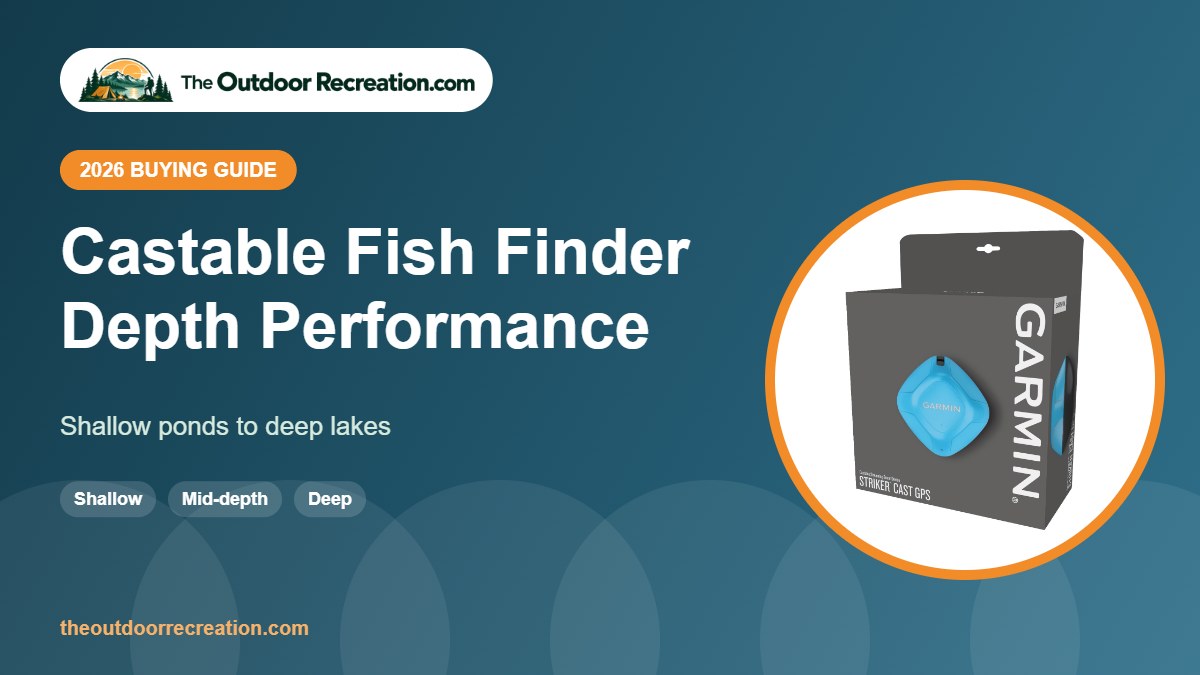
Best Castable Fish Finders for Depth at a Glance
- Best for Shallow and Deep Water: Garmin Striker Cast GPS
- Best Value for Depth: Garmin Striker Cast
- Best Bottom Detail: FishPod 5X Bluetooth Fish Finder
- Best Readout of Depth and Temperature: Portable Rechargeable Wireless Sonar Fish Finder
- Best for Shallow Docks: ReelSonar iBobber Wireless Fish Finder
- Best for Very Deep Water (Non-Castable): Garmin Striker 4 with Portable Kit
- Best Down Imaging (Non-Castable): Humminbird PiranhaMAX 4 DI
Depth Performance Comparison
| Product | Best for | Best depth use | Why | |
|---|---|---|---|---|
| Garmin Striker Cast GPS | Best for Shallow and Deep Water | Shallow to deep | Garmin notes good shallow and deep performance | View |
| Garmin Striker Cast | Best Value for Depth | Shallow to deep | Same sonar, no GPS | View |
| FishPod 5X Bluetooth Fish Finder | Best Bottom Detail | Mid-depth | BottomScan composition | View |
| Portable Rechargeable Wireless Sonar Fish Finder | Best Readout of Depth and Temperature | Ponds and lakes | Depth + temperature display | View |
| ReelSonar iBobber Wireless Fish Finder | Best for Shallow Docks | Shallow | Compact, fish alarm | View |
| Garmin Striker 4 with Portable Kit | Best for Very Deep Water (Non-Castable) | Deep lakes | CHIRP, built-in flasher | View |
| Humminbird PiranhaMAX 4 DI | Best Down Imaging (Non-Castable) | Boats | Down Imaging | View |
The 7 Best Castable Fish Finders for Depth

1The Striker Cast GPS streams traditional 2-D and ice-flasher sonar to the free Striker Cast app from up to 200 ft away. Its built-in GPS lets you build your own maps with 1 ft contours using Quickdraw Contours as you reel it in.
Pros & Cons
What we like
- Built-in GPS mapping
- Trusted Garmin sonar
- Works with Apple and Android
Watch out for
- Needs your phone screen
- Costs more than the non-GPS version
Key Specs
- Sonar: 2-D and ice flasher
- Wireless range: up to 200 ft
- Extra: GPS with Quickdraw Contours

2The standard Striker Cast offers the same rugged castable sonar and 200 ft wireless range without GPS. You can still download maps with up to 1 ft contours in the app.
Pros & Cons
What we like
- Simple setup
- Strong Garmin sonar
- Lower cost than GPS version
Watch out for
- No built-in GPS
- Phone required
Key Specs
- Sonar: 2-D and ice flasher
- Wireless range: up to 200 ft

3FishPod 5X uses four preset modes, FishEcho tuning and BottomScan to separate vegetation from hard bottom. Its TraxNut system fits standard 1/4-20 mounts, so it can be cast or mounted.
Pros & Cons
What we like
- Four preset modes
- Bottom composition readings
- Mountable via 1/4-20
Watch out for
- Phone required
- Smaller owner base
Key Specs
- Modes: 4 presets
- Mount: TraxNut 1/4-20
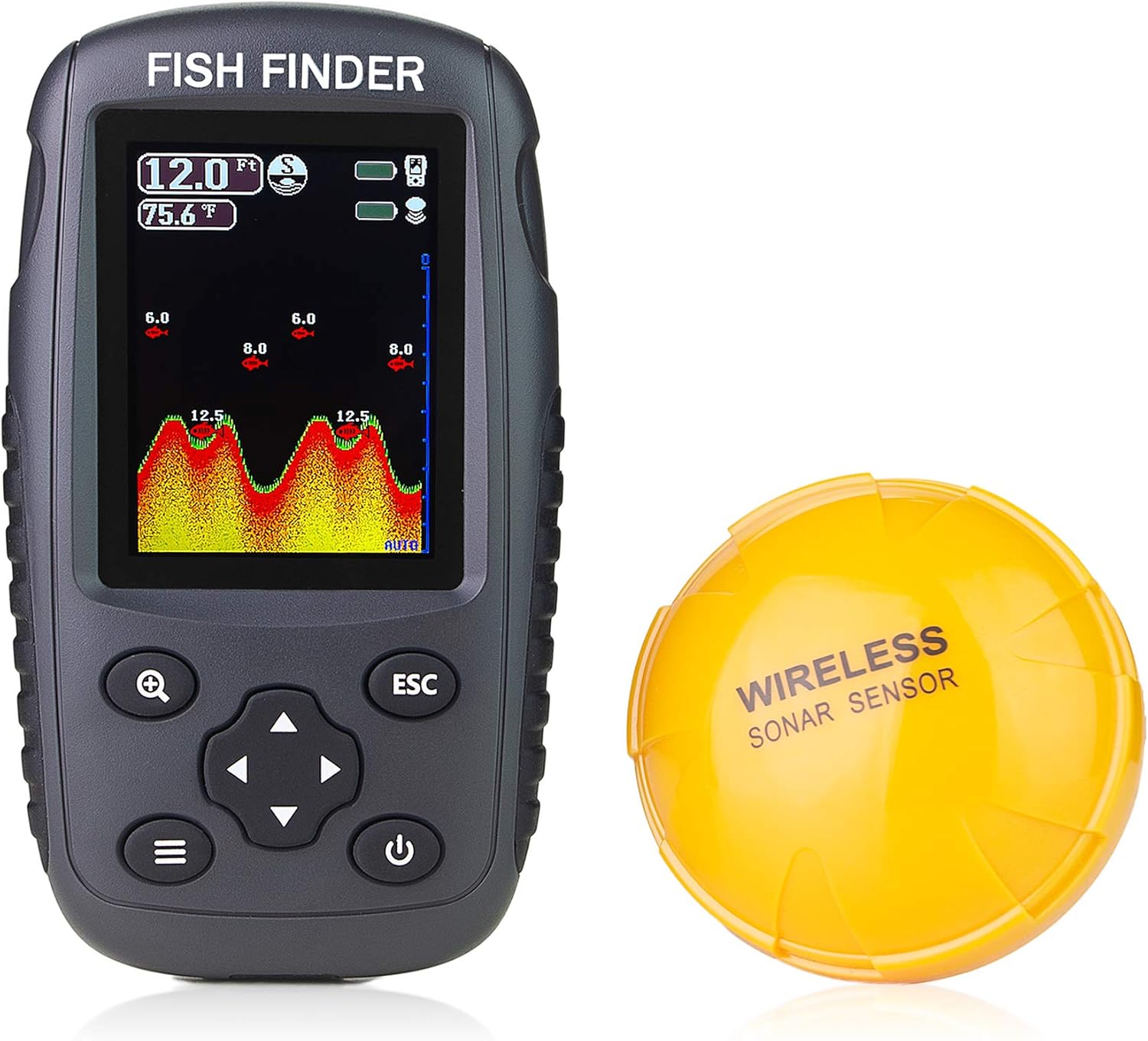
4. Portable Rechargeable Wireless Sonar Fish Finder
4This kit pairs a castable wireless sonar probe with its own color display, so you do not need a phone. It shows depth, water temperature, fish size and fish depth, and has more than 1,100 owner reviews.
Pros & Cons
What we like
- Own display, no phone needed
- Rechargeable
- Shows temperature and fish size
Watch out for
- Basic display
- Less detail than Garmin
Key Specs
- Display: dedicated color screen
- Readings: depth, temperature, fish size

5. ReelSonar iBobber Wireless Fish Finder
5iBobber is a bobber-sized Bluetooth sonar that connects to a phone app and includes a fish alarm that alerts you when fish move below. It is one of the most reviewed castable finders on Amazon.
Pros & Cons
What we like
- Very compact
- Fish alarm
- Large owner base
Watch out for
- Bluetooth range is shorter
- Less detail than Garmin
Key Specs
- Connection: Bluetooth
- Extra: fish alarm

6. Garmin Striker 4 with Portable Kit
6Not castable, but the Striker 4 portable kit is the classic alternative: a dedicated screen, CHIRP sonar, built-in flasher and waypoint map in a carry case.
Pros & Cons
What we like
- Dedicated screen
- CHIRP sonar
- Portable case
Watch out for
- Not castable
- Needs a battery
Key Specs
- Sonar: CHIRP
- Extra: waypoint map, flasher

7. Humminbird PiranhaMAX 4 DI
7Humminbird’s PiranhaMAX 4 DI adds Down Imaging and dual-beam sonar on a 4.3 inch color screen for boats and kayaks.
Pros & Cons
What we like
- Down Imaging
- Dual beam
- Color screen
Watch out for
- Not castable
- Requires mounting
Key Specs
- Display: 4.3 in color
- Sonar: dual beam + Down Imaging
How We Chose
We compared depth-related specs and sonar modes from brand listings with owner feedback on real-world readings. Weighting: depth performance (40%), detail (25%), owner feedback (20%) and value (15%). We did not receive free products, and we do not claim hands-on testing. TOR Scores combine published specs, verified owner feedback and overall value.
What Limits Castable Sonar Depth
- Transducer size and frequency: small pucks have less power than boat units.
- Water clarity and bottom type: soft mud absorbs sound; hard bottoms reflect it.
- Waves and puck angle: tilting reduces accuracy.
- Battery level: low power can weaken signals.
Shallow Water Tips
In very shallow water, readings can be cluttered. Retrieve slowly and watch for weed lines and bottom changes rather than individual fish marks.
Deep Water Tips
Let the puck settle before reading, use flasher mode in ice holes and cast toward drop-offs rather than open flats.
When to Choose a Non-Castable Unit
If you regularly fish very deep reservoirs or offshore, a mounted or portable unit like the Garmin Striker 4 kit or Humminbird PiranhaMAX 4 DI offers more power and detail.
Reading Depth Accurately
- Calibrate or update the app if available.
- Keep the puck upright on a smooth retrieve.
- Compare readings with a known depth or a clip-on weight.
Related: seasonal castable fish finder calendar, castable fish finders with an edge and best castable fish finder.
Common Castable Fish Finder Mistakes
- Using an ultralight rod: it struggles to cast the puck and can break.
- Snapping the cast: lob-cast smoothly to protect the attachment point.
- Retrieving too fast: slow retrieves give clearer readings.
- Casting beyond range: know your device’s real-world wireless limit.
- Skipping a rinse: salt and grit wear down contacts and seals.
Castable Fish Finder Setup Checklist
- Charge the sonar puck and your phone or display the night before.
- Update the app and download maps over home Wi-Fi.
- Spool strong braided line and add a quality snap swivel.
- Pair the device at home so you know the steps by heart.
- Pack a power bank, a microfiber cloth and a waterproof phone case.
A five-minute check at home saves frustration at the water.
Sources and further reading: NOAA Fisheries: recreational fishing resources and Leave No Trace: the 7 Principles. Product specs come from brand listings on Amazon. Always check local fishing regulations before you fish.
Frequently Asked Questions
How deep can a castable fish finder read?
It depends on the model and conditions; check the official specs for each unit.
Which castable fish finder is best for deep water?
The Garmin Striker Cast GPS, which Garmin says performs well in both shallow and deep water.
Why are my depth readings inaccurate?
Waves, puck tilt, soft bottoms and low battery can all affect readings.
Should I use a portable fish finder for deep lakes?
For very deep water, a mounted or portable unit offers more power.
Final Verdict
The Garmin Striker Cast GPS is the best castable fish finder for depth across shallow and deep water. For very deep reservoirs, consider a portable Garmin Striker 4 kit instead.
Write Your Review
No reviews yet. Be the first to share your experience!