

These units stand out across every budget and boat size.
Pick the size and features you need.
The Outdoor Recreation is reader-supported. As an Amazon Associate we earn from qualifying purchases, at no extra cost to you.
Quick Picks
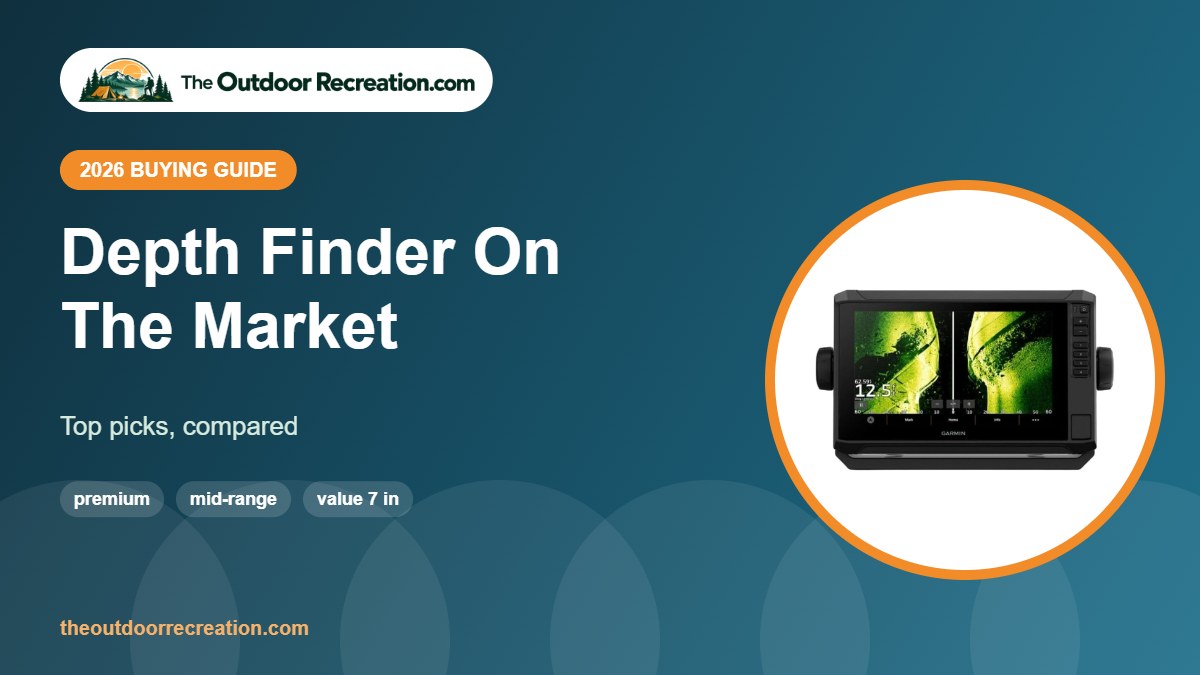
- Best premium: Garmin ECHOMAP UHD2 94sv with GT56
- Best mid-range: Humminbird Helix 7 G4N GPS Fish Finder
- Best value 7 in: Garmin Striker Vivid 7cv
- Best compact: Lowrance HOOK Reveal 5 SplitShot
- Best budget: Garmin STRIKER Vivid 4cv
Comparison Table
| Product | Best for | Key spec | Standout feature | |
|---|---|---|---|---|
| Garmin ECHOMAP UHD2 94sv with GT56 | Best premium | 9 in touchscreen | Side and down imaging | View |
| Humminbird Helix 7 G4N GPS Fish Finder | Best mid-range | 7 in display | MEGA Down Imaging, GPS | View |
| Garmin Striker Vivid 7cv | Best value 7 in | 7 in display | ClearVü + GPS | View |
| Lowrance HOOK Reveal 5 SplitShot | Best compact | 5 in display | SplitShot transducer | View |
| Garmin STRIKER Vivid 4cv | Best budget | 4 in color screen | Vivid scanning sonar | View |
Detailed Reviews

1Garmin’s ECHOMAP UHD2 94sv puts a 9 inch touchscreen chartplotter with ultra-high-definition side and down imaging on your console.
It suits bigger boats and anglers who rely on charts and imaging together.
Pros & Cons
What we like
- Big touchscreen
- Excellent imaging
- Chartplotter
Watch out for
- Needs console space
- Professional install helps
Key Specs
- Screen: 9 in touch
- Transducer: GT56
- Sonar: UHD side and down

2The Humminbird Helix 7 G4N combines dual-spectrum CHIRP sonar, MEGA Down Imaging and built-in GPS on a 7 inch screen.
It is a strong mid-range choice for anglers who want sharp imaging and mapping.
Pros & Cons
What we like
- Sharp imaging
- Built-in GPS
- Networking-ready
Watch out for
- Learning curve
- Larger than kayak units
Key Specs
- Screen: 7 in
- Sonar: CHIRP + MEGA DI
- Extras: GPS, mapping

3The Garmin Striker Vivid 7cv adds a 7 inch screen, vivid color palettes, CHIRP and ClearVü sonar and built-in GPS for waypoints.
Its Quickdraw contours feature lets you make your own maps.
Pros & Cons
What we like
- Big screen for money
- Built-in GPS
- Make your own maps
Watch out for
- No preloaded charts
- Not touchscreen
Key Specs
- Screen: 7 in
- Sonar: CHIRP + ClearVü
- Extras: GPS, Quickdraw

4The Lowrance HOOK Reveal 5 SplitShot pairs a 5 inch screen with a SplitShot transducer for CHIRP and DownScan imaging, plus preloaded maps.
Autotuning sonar makes it simple for beginners.
Pros & Cons
What we like
- Easy to use
- Preloaded maps
- Good value
Watch out for
- Smaller screen
- No side imaging on this version
Key Specs
- Screen: 5 in
- Transducer: SplitShot
- Extras: preloaded maps

5The STRIKER Vivid 4cv is Garmin’s compact entry into color CHIRP sonar with ClearVü scanning, sized for small boats, jon boats and kayaks.
Its simple menus and built-in GPS for marking waypoints make it a favorite first depth finder.
Pros & Cons
What we like
- Easy to learn
- ClearVü scanning
- Waypoint GPS
Watch out for
- Small screen
- No preloaded maps
Key Specs
- Screen: 4 in color
- Sonar: CHIRP + ClearVü
- Transducer: GT20-TM included
How We Chose
We compared screen size, sonar type, GPS and charts, transducer options and power needs across dozens of depth finders and accessories, then read verified owner feedback on readability, installation and reliability. We did not receive free products, and we do not claim hands-on testing. TOR Scores combine published specs, verified owner feedback and overall value. We cover this in more depth in our roundup of the best depth finder on a budget.
How to Choose a Depth Finder
- Screen size: 4 to 5 inches suits kayaks and small boats; 7 to 9 inches is easier to read on larger boats.
- Sonar type: traditional CHIRP for depth and fish arches, down imaging for detail under the boat, side imaging for scanning wide areas.
- GPS and maps: built-in GPS marks waypoints; chartplotter combos add lake or coastal charts.
- Transducer mount: transom, trolling motor, through-hull or portable clamp.
- Power: most units run on 12V; kayaks and portable kits need a small battery.
Match the unit to your boat and water first, then add features you will actually use.
Choosing a Depth Finder by Budget
Price bands for depth finders overlap a lot, so think in terms of features rather than dollars. Entry-level units give you clear 2D sonar, depth and water temperature on a 4 to 5 inch screen. They are perfect for small boats, kayaks and anglers who mainly want to know depth and spot fish arches. You may also find our guide to the best depth finder you can buy helpful.
Mid-range units add down imaging or side imaging, built-in GPS and often lake maps. These are the sweet spot for most boat owners because imaging makes structure much easier to read and GPS lets you save spots. Screens grow to 7 inches here, which is easier to read from the console.
Premium units add larger touchscreens, networking with trolling motors and other displays, and advanced live sonar options. They are powerful but take time to learn and usually need professional installation. We do not list exact prices because they change often; use the buttons to see current offers and bundles.
Lake Maps, Charts and Mapping Features
Built-in maps are one of the biggest differences between basic depth finders and fish finder chartplotters. Many mid-range units come with preloaded U.S. lake maps and coastal charts showing contours, structure and hazards. Some let you create your own high-detail maps as you drive, which is useful on small lakes that are not well mapped. Related: our shortlist of the best castable fish finder on the market.
Look for features like depth range shading, which highlights a band of depth you want to fish, and shallow water shading, which warns you as the bottom comes up. Waypoints let you mark brush piles, humps and productive spots so you can return to them later.
Remember that electronic charts can be out of date or wrong in shallow or changing waters. Use them alongside official charts, buoys and your own eyes. The NOAA Office of Coast Survey publishes official nautical charts for U.S. coastal waters.
Depth Finder vs Fish Finder
A depth finder, or depth sounder, uses sonar to measure how deep the water is under your boat. A fish finder uses the same sonar but also shows fish arches, bait, structure and bottom hardness on a screen. Today almost every fish finder doubles as a depth finder, so most boaters buy one unit that does both.
Basic depth sounders and handheld units are cheapest and simplest. Fish finders with CHIRP, down imaging or side imaging cost more but show far more detail, and chartplotter combos add GPS maps for navigation. If you are comparing options, our guide to the best depth finder camera options is worth a look.
Depth Finder Installation Basics
Most small-boat depth finders use a transom-mount transducer. Mount it where water flows smoothly, away from the propeller wash, strakes and rivets, with the face level with or slightly below the hull bottom. Run the cable to the console, secure it with clips, and connect power to a fused 12V source.
Kayaks and canoes often use scupper or arm mounts, while rental boats and jon boats can use a clamp-on portable bracket. Always follow the manufacturer’s instructions; a poorly placed transducer is the most common cause of bad readings at speed.
Related guides: best depth finder on amazon, best depth finder options, best depth finder. See every pick in our Fish Finders category.
Sources and further reading: NOAA Fisheries: recreational fishing resources and Leave No Trace: the 7 Principles. Product specs come from brand listings on Amazon. Always check local fishing regulations before you fish.
Frequently Asked Questions
What is the difference between a depth finder and a fish finder?
A depth finder measures water depth; a fish finder also shows fish, structure and bottom detail. Most fish finders work as depth finders.
Do I need GPS on a depth finder?
Not for depth alone, but GPS lets you mark spots and navigate back to them.
Can I install a depth finder myself?
Many small-boat units are DIY friendly; follow the transducer placement guidance carefully.
Will a depth finder work in shallow water?
Yes, though readings can be less stable in very shallow, weedy water.
Do depth finders need an app?
Most console units work without an app; castable sonars need a phone app.
Final Verdict
The Garmin ECHOMAP UHD2 94sv leads the market for serious anglers.
Write Your Review
No reviews yet. Be the first to share your experience!