

There are more types of depth finder than most people expect.
Here are the main options.
The Outdoor Recreation is reader-supported. As an Amazon Associate we earn from qualifying purchases, at no extra cost to you.
Quick Picks
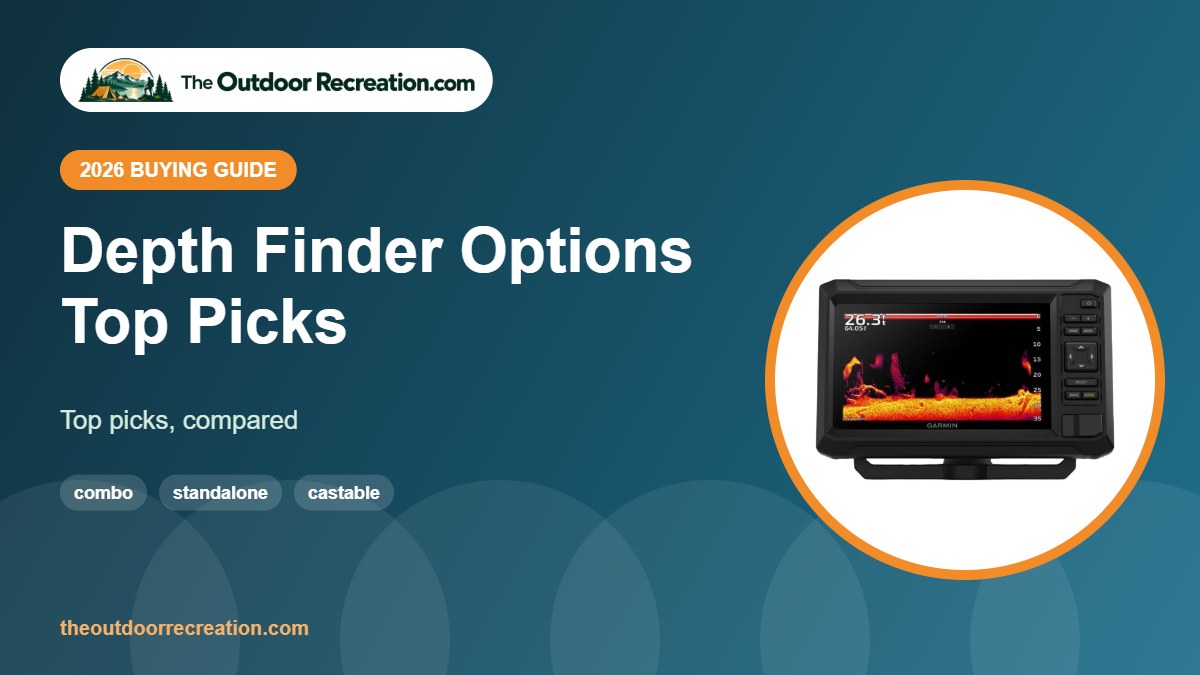
- Best combo: Garmin ECHOMAP UHD2 73cv with US Inland Maps
- Best standalone: Garmin STRIKER Vivid 4cv
- Best castable: Deeper PRO+ 2 Smart Sonar
- Best handheld: Hawkeye DT1H Handheld Depth Finder
- Best depth gauge: DepthTrax 2B In-Dash Digital Depth Finder
Comparison Table
| Product | Best for | Key spec | Standout feature | |
|---|---|---|---|---|
| Garmin ECHOMAP UHD2 73cv with US Inland Maps | Best combo | 7 in display | Preloaded U.S. inland maps | View |
| Garmin STRIKER Vivid 4cv | Best standalone | 4 in color screen | Vivid scanning sonar | View |
| Deeper PRO+ 2 Smart Sonar | Best castable | Built-in GPS + Wi-Fi | Onshore bathymetric mapping | View |
| Hawkeye DT1H Handheld Depth Finder | Best handheld | Handheld sounder | Point and read | View |
| DepthTrax 2B In-Dash Digital Depth Finder | Best depth gauge | In-dash digital | Depth-only readout | View |
Detailed Reviews

1This ECHOMAP UHD2 73cv bundle includes preloaded U.S. inland lake maps and a GT20 transducer for CHIRP and ClearVü imaging.
It is a strong pick for lake anglers who want maps out of the box.
Pros & Cons
What we like
- Inland maps included
- Clear imaging
- Mid-size screen
Watch out for
- No side imaging on cv model
- Map coverage varies by lake
Key Specs
- Screen: 7 in
- Maps: U.S. inland
- Transducer: GT20-TM

2The STRIKER Vivid 4cv is Garmin’s compact entry into color CHIRP sonar with ClearVü scanning, sized for small boats, jon boats and kayaks.
Its simple menus and built-in GPS for marking waypoints make it a favorite first depth finder.
Pros & Cons
What we like
- Easy to learn
- ClearVü scanning
- Waypoint GPS
Watch out for
- Small screen
- No preloaded maps
Key Specs
- Screen: 4 in color
- Sonar: CHIRP + ClearVü
- Transducer: GT20-TM included

3The Deeper PRO+ 2 is a castable smart sonar with built-in GPS and Wi-Fi, so it maps the bottom as you reel in, even from shore.
It connects to the Deeper app on your phone and is a favorite of bank anglers, kayakers and ice anglers who want maps and sonar in one small ball.
Pros & Cons
What we like
- GPS mapping from shore
- Wi-Fi link for long range
- Works year-round including ice
Watch out for
- Premium price
- App features take time to learn
Key Specs
- Connection: Wi-Fi
- GPS: built in
- Use: shore, kayak, boat, ice

4The Hawkeye DT1H is a handheld depth sounder you dip into the water to read depth and water temperature.
It is handy for checking depth from docks, kayaks, ice holes and small boats without installing anything.
Pros & Cons
What we like
- No install
- Reads depth and temperature
- Pocket size
Watch out for
- No fish display
- Must be held in water
Key Specs
- Type: handheld sounder
- Reads: depth, temperature
- Power: batteries

5The DepthTrax 2B is a simple in-dash digital depth finder that shows depth in large numbers rather than a sonar picture.
It is ideal for pontoons and runabouts where you just need to know the depth.
Pros & Cons
What we like
- Very simple
- Large readout
- Dash mount
Watch out for
- No fish display
- Install needed
Key Specs
- Type: digital depth gauge
- Mount: in-dash
- Display: numeric depth
How We Chose
We compared screen size, sonar type, GPS and charts, transducer options and power needs across dozens of depth finders and accessories, then read verified owner feedback on readability, installation and reliability. We did not receive free products, and we do not claim hands-on testing. TOR Scores combine published specs, verified owner feedback and overall value. We cover this in more depth in our roundup of the best castable fish finder options.
Depth Finder vs Fish Finder
A depth finder, or depth sounder, uses sonar to measure how deep the water is under your boat. A fish finder uses the same sonar but also shows fish arches, bait, structure and bottom hardness on a screen. Today almost every fish finder doubles as a depth finder, so most boaters buy one unit that does both.
Basic depth sounders and handheld units are cheapest and simplest. Fish finders with CHIRP, down imaging or side imaging cost more but show far more detail, and chartplotter combos add GPS maps for navigation. You may also find our guide to the best depth finder on a budget helpful.
How to Choose a Depth Finder
- Screen size: 4 to 5 inches suits kayaks and small boats; 7 to 9 inches is easier to read on larger boats.
- Sonar type: traditional CHIRP for depth and fish arches, down imaging for detail under the boat, side imaging for scanning wide areas.
- GPS and maps: built-in GPS marks waypoints; chartplotter combos add lake or coastal charts.
- Transducer mount: transom, trolling motor, through-hull or portable clamp.
- Power: most units run on 12V; kayaks and portable kits need a small battery.
Match the unit to your boat and water first, then add features you will actually use.
Choosing a Depth Finder by Budget
Price bands for depth finders overlap a lot, so think in terms of features rather than dollars. Entry-level units give you clear 2D sonar, depth and water temperature on a 4 to 5 inch screen. They are perfect for small boats, kayaks and anglers who mainly want to know depth and spot fish arches.
Mid-range units add down imaging or side imaging, built-in GPS and often lake maps. These are the sweet spot for most boat owners because imaging makes structure much easier to read and GPS lets you save spots. Screens grow to 7 inches here, which is easier to read from the console. Related: our shortlist of the best depth finder you can buy.
Premium units add larger touchscreens, networking with trolling motors and other displays, and advanced live sonar options. They are powerful but take time to learn and usually need professional installation. We do not list exact prices because they change often; use the buttons to see current offers and bundles.
Depth Finder Installation Basics
Most small-boat depth finders use a transom-mount transducer. Mount it where water flows smoothly, away from the propeller wash, strakes and rivets, with the face level with or slightly below the hull bottom. Run the cable to the console, secure it with clips, and connect power to a fused 12V source.
Kayaks and canoes often use scupper or arm mounts, while rental boats and jon boats can use a clamp-on portable bracket. Always follow the manufacturer’s instructions; a poorly placed transducer is the most common cause of bad readings at speed. If you are comparing options, our guide to the best depth finder camera options is worth a look.
Reading Depth and Bottom on the Screen
The depth number in the corner is the most important reading. The bottom shows as a thick band: a hard bottom such as rock returns a brighter, thicker line, while mud and weeds return a softer, thinner line. Fish usually appear as arches when the boat is moving and lines when you sit still.
Turn sensitivity up until you see a little clutter, then back it off. Use zoom and split views to focus on the bottom few feet where many fish feed.
Related guides: best depth finder on the market, best depth finder system, best depth finder. See every pick in our Fish Finders category.
Sources and further reading: NOAA Fisheries: recreational fishing resources and Leave No Trace: the 7 Principles. Product specs come from brand listings on Amazon. Always check local fishing regulations before you fish.
Frequently Asked Questions
What is the difference between a depth finder and a fish finder?
A depth finder measures water depth; a fish finder also shows fish, structure and bottom detail. Most fish finders work as depth finders.
Do I need GPS on a depth finder?
Not for depth alone, but GPS lets you mark spots and navigate back to them.
Can I install a depth finder myself?
Many small-boat units are DIY friendly; follow the transducer placement guidance carefully.
Will a depth finder work in shallow water?
Yes, though readings can be less stable in very shallow, weedy water.
Do depth finders need an app?
Most console units work without an app; castable sonars need a phone app.
Final Verdict
Most anglers are happiest with a combo like the ECHOMAP UHD2 73cv.


Write Your Review
No reviews yet. Be the first to share your experience!