

A complete system is more than the screen.
These setups cover common boats.
The Outdoor Recreation is reader-supported. As an Amazon Associate we earn from qualifying purchases, at no extra cost to you.
Quick Picks
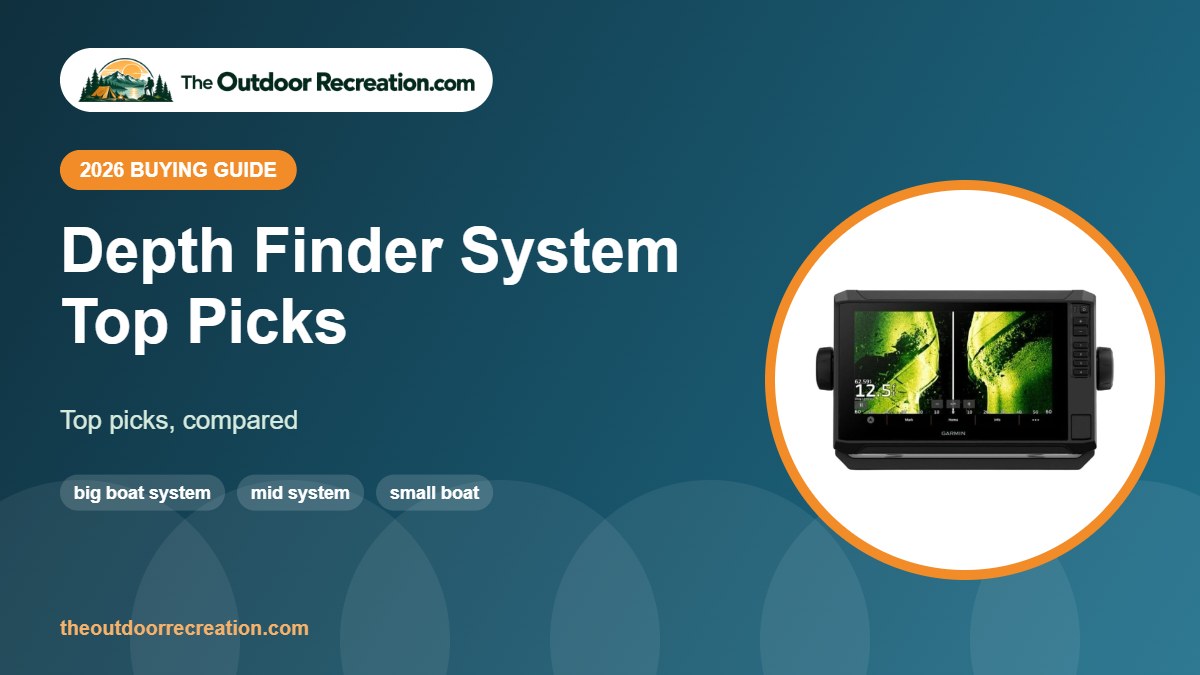
- Best big boat system: Garmin ECHOMAP UHD2 94sv with GT56
- Best mid system: Garmin ECHOMAP UHD2 73cv with US Inland Maps
- Best small boat: Lowrance HOOK Reveal 5 SplitShot
- Best portable system: Garmin Striker 4 with Portable Kit
- Best battery: 12V 15Ah LiFePO4 Deep Cycle Battery
Comparison Table
| Product | Best for | Key spec | Standout feature | |
|---|---|---|---|---|
| Garmin ECHOMAP UHD2 94sv with GT56 | Best big boat system | 9 in touchscreen | Side and down imaging | View |
| Garmin ECHOMAP UHD2 73cv with US Inland Maps | Best mid system | 7 in display | Preloaded U.S. inland maps | View |
| Lowrance HOOK Reveal 5 SplitShot | Best small boat | 5 in display | SplitShot transducer | View |
| Garmin Striker 4 with Portable Kit | Best portable system | 3.5 in screen + GPS | CHIRP sonar | View |
| 12V 15Ah LiFePO4 Deep Cycle Battery | Best battery | 12V 15Ah | Up to 8000+ cycles | View |
Detailed Reviews

1Garmin’s ECHOMAP UHD2 94sv puts a 9 inch touchscreen chartplotter with ultra-high-definition side and down imaging on your console.
It suits bigger boats and anglers who rely on charts and imaging together.
Pros & Cons
What we like
- Big touchscreen
- Excellent imaging
- Chartplotter
Watch out for
- Needs console space
- Professional install helps
Key Specs
- Screen: 9 in touch
- Transducer: GT56
- Sonar: UHD side and down

2. Garmin ECHOMAP UHD2 73cv with US Inland Maps
2This ECHOMAP UHD2 73cv bundle includes preloaded U.S. inland lake maps and a GT20 transducer for CHIRP and ClearVü imaging.
It is a strong pick for lake anglers who want maps out of the box.
Pros & Cons
What we like
- Inland maps included
- Clear imaging
- Mid-size screen
Watch out for
- No side imaging on cv model
- Map coverage varies by lake
Key Specs
- Screen: 7 in
- Maps: U.S. inland
- Transducer: GT20-TM

3The Lowrance HOOK Reveal 5 SplitShot pairs a 5 inch screen with a SplitShot transducer for CHIRP and DownScan imaging, plus preloaded maps.
Autotuning sonar makes it simple for beginners.
Pros & Cons
What we like
- Easy to use
- Preloaded maps
- Good value
Watch out for
- Smaller screen
- No side imaging on this version
Key Specs
- Screen: 5 in
- Transducer: SplitShot
- Extras: preloaded maps

4The Garmin Striker 4 with Portable Kit packs a CHIRP sonar fish finder, GPS waypoint map, battery and carrying case for ice fishing or moving between boats.
It is a dedicated-screen alternative to castable sonar, with simple buttons and a waypoint map to mark brush piles, stumps and docks.
Pros & Cons
What we like
- CHIRP sonar
- GPS waypoints
- Portable kit included
Watch out for
- Transducer is not castable
- Small screen
Key Specs
- Screen: 3.5 in
- Sonar: CHIRP
- Extras: GPS, portable case and battery

5This 12V 15Ah LiFePO4 battery is light and long-lasting, a good fit for kayak and small boat fish finders.
Lithium iron phosphate batteries hold voltage well and last far more cycles than lead-acid batteries.
Pros & Cons
What we like
- Light
- Long cycle life
- Steady voltage
Watch out for
- Needs a lithium-compatible charger
- Costs more than SLA
Key Specs
- Type: LiFePO4
- Capacity: 15Ah
- Voltage: 12V
How We Chose
We compared screen size, sonar type, GPS and charts, transducer options and power needs across dozens of depth finders and accessories, then read verified owner feedback on readability, installation and reliability. We did not receive free products, and we do not claim hands-on testing. TOR Scores combine published specs, verified owner feedback and overall value. We cover this in more depth in our roundup of the best depth finder with a mapping system.
Depth Finder Installation Basics
Most small-boat depth finders use a transom-mount transducer. Mount it where water flows smoothly, away from the propeller wash, strakes and rivets, with the face level with or slightly below the hull bottom. Run the cable to the console, secure it with clips, and connect power to a fused 12V source.
Kayaks and canoes often use scupper or arm mounts, while rental boats and jon boats can use a clamp-on portable bracket. Always follow the manufacturer’s instructions; a poorly placed transducer is the most common cause of bad readings at speed.
Power, Batteries and Wiring
Boat-mounted depth finders usually run from the boat’s 12V battery through an inline fuse. Kayaks and portable kits use a small sealed lead-acid or lithium battery; a 12V lithium iron phosphate battery saves weight and lasts longer between charges. You may also find our guide to the best castable fish finder system helpful.
Use marine-grade wire and connectors, keep connections dry, and charge batteries with a charger that matches the battery chemistry.
How to Choose a Depth Finder
- Screen size: 4 to 5 inches suits kayaks and small boats; 7 to 9 inches is easier to read on larger boats.
- Sonar type: traditional CHIRP for depth and fish arches, down imaging for detail under the boat, side imaging for scanning wide areas.
- GPS and maps: built-in GPS marks waypoints; chartplotter combos add lake or coastal charts.
- Transducer mount: transom, trolling motor, through-hull or portable clamp.
- Power: most units run on 12V; kayaks and portable kits need a small battery.
Match the unit to your boat and water first, then add features you will actually use.
Depth Finder vs Fish Finder
A depth finder, or depth sounder, uses sonar to measure how deep the water is under your boat. A fish finder uses the same sonar but also shows fish arches, bait, structure and bottom hardness on a screen. Today almost every fish finder doubles as a depth finder, so most boaters buy one unit that does both.
Basic depth sounders and handheld units are cheapest and simplest. Fish finders with CHIRP, down imaging or side imaging cost more but show far more detail, and chartplotter combos add GPS maps for navigation. Related: our shortlist of the best depth finder.
Reading Depth and Bottom on the Screen
The depth number in the corner is the most important reading. The bottom shows as a thick band: a hard bottom such as rock returns a brighter, thicker line, while mud and weeds return a softer, thinner line. Fish usually appear as arches when the boat is moving and lines when you sit still.
Turn sensitivity up until you see a little clutter, then back it off. Use zoom and split views to focus on the bottom few feet where many fish feed.
GPS, Maps and Navigation
A depth finder with GPS lets you save waypoints for productive spots, docks and hazards, and retrace your track back to the ramp. Chartplotter combos add lake or coastal maps with depth contours, and some units can build your own contour maps as you drive. If you are comparing options, our guide to the best depth finder on a budget is worth a look.
For navigation, depth readings help you avoid shallow bars and rocks, but they are not a substitute for charts, local knowledge and careful boat handling. Always keep a lookout and slow down in unfamiliar water.
Caring for Your Depth Finder
Rinse the transducer and mount after saltwater use, keep the transducer face clean of growth and paint, and store the display under a sun cover or remove it when the boat is parked. UV and heat are hard on screens over time.
Check cable runs for chafing each season and keep software up to date so maps and sonar features work properly.
Related guides: best depth finder options, best depth finder setup, best depth finder kit. See every pick in our Fish Finders category.
Sources and further reading: NOAA Fisheries: recreational fishing resources and Leave No Trace: the 7 Principles. Product specs come from brand listings on Amazon. Always check local fishing regulations before you fish.
Frequently Asked Questions
What is the difference between a depth finder and a fish finder?
A depth finder measures water depth; a fish finder also shows fish, structure and bottom detail. Most fish finders work as depth finders.
Do I need GPS on a depth finder?
Not for depth alone, but GPS lets you mark spots and navigate back to them.
Can I install a depth finder myself?
Many small-boat units are DIY friendly; follow the transducer placement guidance carefully.
Will a depth finder work in shallow water?
Yes, though readings can be less stable in very shallow, weedy water.
Do depth finders need an app?
Most console units work without an app; castable sonars need a phone app.
Final Verdict
For most boats, the ECHOMAP UHD2 73cv is a complete system.


Write Your Review
No reviews yet. Be the first to share your experience!