

Anglers searching for a castable fish finder “anchor” usually want one of two things: a way to keep the sonar puck sitting over one spot, or a way to hold their kayak still while they watch the screen. Both let you study a brush pile, drop-off or ice hole without the readings drifting.
We explain both setups and pick the castable finders and mounts that work best when anchored, based on specs and owner feedback.
The Outdoor Recreation is reader-supported. As an Amazon Associate we earn from qualifying purchases, at no extra cost to you.
Best Anchored Castable Setups at a Glance
- Best for Anchored Spot Scanning: Garmin Striker Cast GPS
- Best Stationary Flasher Use: Garmin Striker Cast
- Best for Anchored Kayaks: FishPod 5X Bluetooth Fish Finder
- Best Kayak Transducer Mount: Fish Finder Track Mount with Transducer Arm
- Best Dock Spot Watcher: ReelSonar iBobber Wireless Fish Finder
- Best Floating Sensor: Portable Wireless Sonar and Radio Fish Finder
- Best Anchored Camera: FishPRO Underwater Fishing Camera 4.3 in
Anchored Setup Comparison
| Product | Best for | Anchored use | Why it works | |
|---|---|---|---|---|
| Garmin Striker Cast GPS | Best for Anchored Spot Scanning | Mark and return | GPS marks the spot | View |
| Garmin Striker Cast | Best Stationary Flasher Use | Ice hole or dock | Flasher mode | View |
| FishPod 5X Bluetooth Fish Finder | Best for Anchored Kayaks | Kayak mounted | 1/4-20 mount | View |
| Fish Finder Track Mount with Transducer Arm | Best Kayak Transducer Mount | Mount at anchor | Extendable arm | View |
| ReelSonar iBobber Wireless Fish Finder | Best Dock Spot Watcher | Tethered at dock | Fish alarm | View |
| Portable Wireless Sonar and Radio Fish Finder | Best Floating Sensor | Float or tie off | Trollable sensor | View |
| FishPRO Underwater Fishing Camera 4.3 in | Best Anchored Camera | Stationary view | See fish directly | View |
The 7 Best Picks for Anchored Castable Sonar

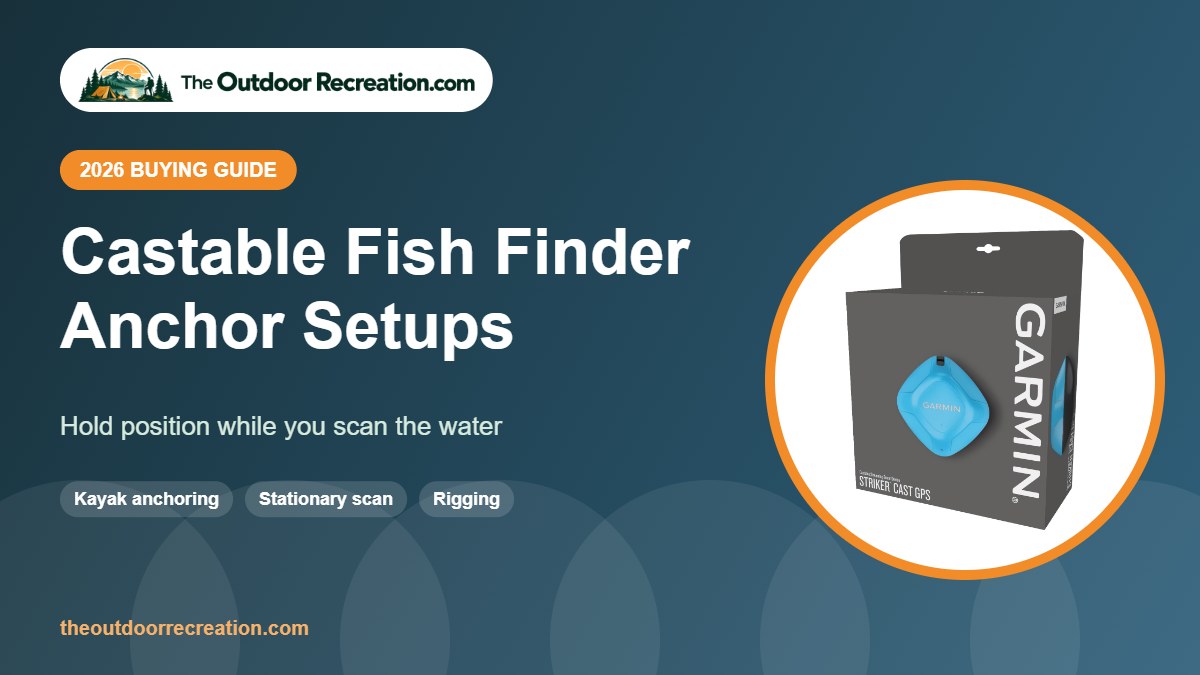
1The Striker Cast GPS streams traditional 2-D and ice-flasher sonar to the free Striker Cast app from up to 200 ft away. Its built-in GPS lets you build your own maps with 1 ft contours using Quickdraw Contours as you reel it in.
Pros & Cons
What we like
- Built-in GPS mapping
- Trusted Garmin sonar
- Works with Apple and Android
Watch out for
- Needs your phone screen
- Costs more than the non-GPS version
Key Specs
- Sonar: 2-D and ice flasher
- Wireless range: up to 200 ft
- Extra: GPS with Quickdraw Contours

2The standard Striker Cast offers the same rugged castable sonar and 200 ft wireless range without GPS. You can still download maps with up to 1 ft contours in the app.
Pros & Cons
What we like
- Simple setup
- Strong Garmin sonar
- Lower cost than GPS version
Watch out for
- No built-in GPS
- Phone required
Key Specs
- Sonar: 2-D and ice flasher
- Wireless range: up to 200 ft

3FishPod 5X uses four preset modes, FishEcho tuning and BottomScan to separate vegetation from hard bottom. Its TraxNut system fits standard 1/4-20 mounts, so it can be cast or mounted.
Pros & Cons
What we like
- Four preset modes
- Bottom composition readings
- Mountable via 1/4-20
Watch out for
- Phone required
- Smaller owner base
Key Specs
- Modes: 4 presets
- Mount: TraxNut 1/4-20

4. Fish Finder Track Mount with Transducer Arm
4For kayak and SUP anglers, this track mount combines a 1.5 inch ball mount and an extendable transducer arm. It suits mountable units like FishPod 5X.
Pros & Cons
What we like
- 360 degree adjust
- Extendable arm
- Kayak-friendly
Watch out for
- Needs a track
- Not for casting
Key Specs
- Ball: 1.5 in
- Mount: track base

5. ReelSonar iBobber Wireless Fish Finder
5iBobber is a bobber-sized Bluetooth sonar that connects to a phone app and includes a fish alarm that alerts you when fish move below. It is one of the most reviewed castable finders on Amazon.
Pros & Cons
What we like
- Very compact
- Fish alarm
- Large owner base
Watch out for
- Bluetooth range is shorter
- Less detail than Garmin
Key Specs
- Connection: Bluetooth
- Extra: fish alarm

6. Portable Wireless Sonar and Radio Fish Finder
6A wireless sensor with its own LED display and two frequencies. You can float the sensor, tie it to a rod or mount it on a boat for trolling.
Pros & Cons
What we like
- No phone needed
- Trollable
- Rechargeable
Watch out for
- Few reviews
- Basic readings
Key Specs
- Display: dedicated LED screen

7. FishPRO Underwater Fishing Camera 4.3 in
7When sonar is not enough, an underwater camera shows you what fish are doing. FishPRO pairs a 1000TVL camera with a 4.3 inch IPS screen and a magnetic spool for cable control.
Pros & Cons
What we like
- See fish directly
- IPS screen
- Magnetic cable spool
Watch out for
- Not castable
- Best for ice and docks
Key Specs
- Camera: 1000TVL
- Screen: 4.3 in IPS
How We Chose
We compared units by how well they work while stationary or anchored, including flasher modes, GPS marking and mounting options. Weighting: stationary usefulness (35%), sonar quality (25%), owner feedback (25%) and value (15%). We did not receive free products, and we do not claim hands-on testing. TOR Scores combine published specs, verified owner feedback and overall value.
Two Ways to “Anchor” a Castable Fish Finder
1. Hold the puck over one spot
Cast past the target, retrieve until the puck sits over it, then keep tension. In current, a small inline weight on a dropper below the puck (only if the manufacturer allows) can reduce drift. From docks and ice holes, simply lower the puck straight down.
2. Anchor the kayak and mount the sonar
A kayak anchor trolley or stake-out pole holds you in place while a mounted unit, such as FishPod 5X on a track arm, shows what is below.
Tips for Stationary Scanning
- Use GPS waypoints to return to productive spots.
- Switch to flasher mode to watch fish react to your lure in real time.
- Keep the puck upright and still for the clearest readings.
- In wind, anchor from the bow or stern to keep the kayak aligned.
Safety Notes
Never anchor a kayak from the side, which can tip it in current. Use a quick-release system and a knife within reach, and wear a life jacket.
When to Keep Moving Instead
Anchoring is best once you have found fish. To find them, keep casting and retrieving to cover water first.
Related: castable fish finder brackets, castable fish finder line and cable and best castable fish finder.
Common Castable Fish Finder Mistakes
- Using an ultralight rod: it struggles to cast the puck and can break.
- Snapping the cast: lob-cast smoothly to protect the attachment point.
- Retrieving too fast: slow retrieves give clearer readings.
- Casting beyond range: know your device’s real-world wireless limit.
- Skipping a rinse: salt and grit wear down contacts and seals.
Sources and further reading: NOAA Fisheries: recreational fishing resources and Leave No Trace: the 7 Principles. Product specs come from brand listings on Amazon. Always check local fishing regulations before you fish.
Frequently Asked Questions
How do I keep a castable fish finder in one spot?
Hold tension over the target, lower it straight down from a dock or ice hole, or mount a compatible unit to an anchored kayak.
Can I anchor a kayak while using a fish finder?
Yes. Use a bow or stern anchor trolley and a mounted unit or castable puck.
Which castable finder is best for stationary use?
Garmin Striker Cast, thanks to its flasher mode and GPS marking on the GPS model.
Is it safe to anchor a kayak?
Yes with proper technique: anchor from bow or stern, use a quick release and wear a life jacket.
Final Verdict
The Garmin Striker Cast GPS is the best castable fish finder for anchored scanning thanks to GPS marks and flasher mode. For anchored kayaks, mount the FishPod 5X on a track arm.
Write Your Review
No reviews yet. Be the first to share your experience!