

A day hike pack should carry the essentials without weighing you down.
These are our 2026 picks.
The Outdoor Recreation is reader-supported. As an Amazon Associate we earn from qualifying purchases, at no extra cost to you.
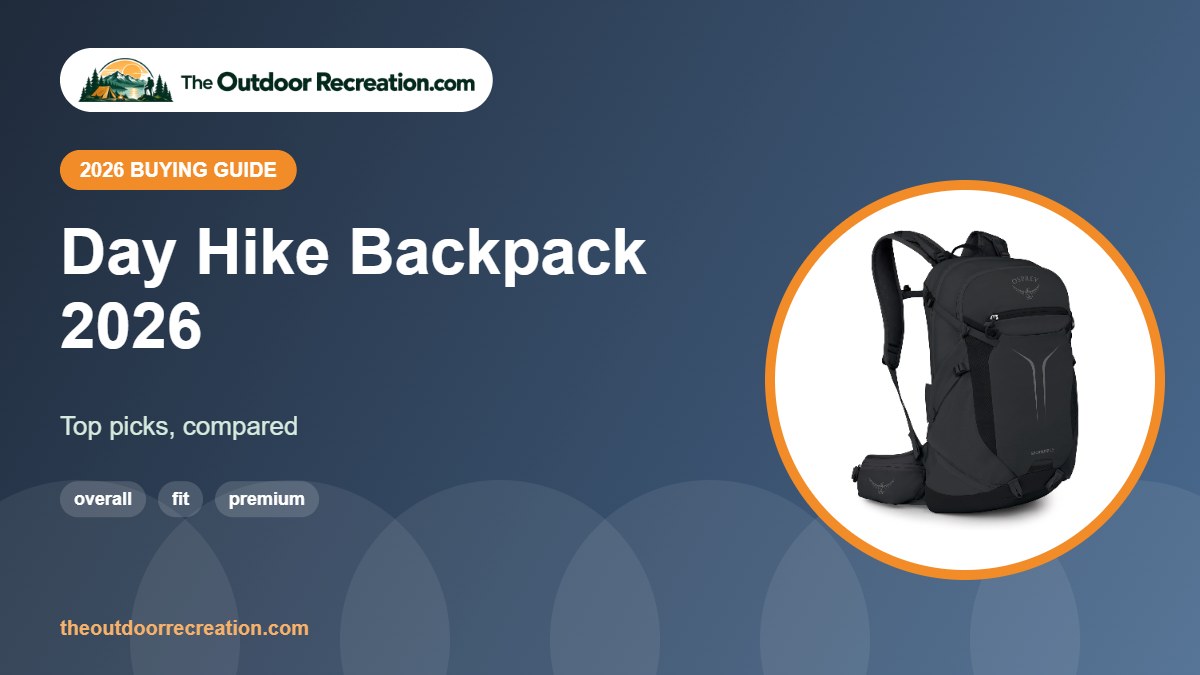
Quick Picks
- Best overall: Osprey Sportlite 25L Daypack
- Best fit: Osprey Talon Pro 40
- Best premium: Arc’teryx Mantis 26
- Best for rough trails: Osprey Kestrel LT 35
- Best packable: MIYCOO Ultralight Packable 35L
Comparison Table
| Product | Best for | Capacity | Standout feature | |
|---|---|---|---|---|
| Osprey Sportlite 25L Daypack | Best overall | 25L | Lightweight daypack | View |
| Osprey Talon Pro 40 | Best fit | 40L | NanoFly UHMWPE ripstop | View |
| Arc’teryx Mantis 26 | Best premium | 26 L | Versatile daypack | View |
| Osprey Kestrel LT 35 | Best for rough trails | 35L | Adjustable torso, raincover | View |
| MIYCOO Ultralight Packable 35L | Best packable | 35L | Folds to 4.5 x 3.9 x 7.8 in | View |
Detailed Reviews

1The Osprey Sportlite 25 is a lightweight daypack sized for water, layers, food and the Ten Essentials.
It is a simple, comfortable pack for day hikes and travel days.
Pros & Cons
What we like
- Light
- Comfortable
- Right size for day hikes
Watch out for
- Limited frame
- Few extras
Key Specs
- Capacity: 25L
- Type: daypack
- Use: day hikes

2The Talon Pro 40 is Osprey’s light, fast multi-sport pack. NanoFly fabric with a triple-grid UHMWPE ripstop gives it strength well beyond its weight, and the stretch pockets are tougher than standard mesh.
It is versatile enough for long day hikes, scrambles, fastpacking and alpine approaches. It has a men’s fit and a hip belt.
Pros & Cons
What we like
- Very strong for its weight
- Durable stretch pockets
- Versatile multi-sport design
Watch out for
- Premium pricing
- Men’s fit only in this listing
Key Specs
- Capacity: 40 liters
- Fabric: NanoFly with UHMWPE ripstop
- Fit: men’s, with hip belt
- Use: hiking, scrambling, fastpacking

3The Arc’teryx Mantis 26 is a versatile daypack that pairs well with a big pack as a summit or town bag.
It shows Arc’teryx build quality at a smaller size.
Pros & Cons
What we like
- Arc’teryx quality
- Versatile
- Comfortable
Watch out for
- Daypack only
- Pricier
Key Specs
- Capacity: 26 L
- Type: daypack
- Use: day hikes, travel

4The Kestrel LT 35 is a classic top-loading rucksack with a men’s fit and an adjustable torso length, so you can dial it to your back instead of hoping a fixed size works.
Osprey gives it a fixed top lid with a zip pocket, stretch side pockets, a front shove-it pocket, trekking pole attachments and a side zip that reaches into the main compartment without unloading from the top. It ships with a raincover. At 35 liters it is the right size for long day hikes and efficient overnights where you carry a light sleep system.
Pros & Cons
What we like
- Adjustable torso length
- Side-zip access to main compartment
- Raincover included
Watch out for
- Men’s fit only in this listing
- 35L is tight for cold-weather overnights
Key Specs
- Capacity: 35 liters
- Fit: men’s, adjustable torso
- Loading: top lid plus side zip
- Raincover: included
- Extras: trekking pole attachment, shove-it pocket

5MIYCOO’s packable daypack folds down to about 4.5 x 3.9 x 7.8 inches and, according to the brand, weighs about half as much as a phone. Unfolded, it is 12.5 x 8.5 x 20.9 inches.
The fabric has an IPX4 splash rating, so light rain is fine but a downpour is not. It is the lightest way to carry 35 liters, but there is no padding, so keep loads small.
Pros & Cons
What we like
- Folds very small
- IPX4 splash resistance
- Extremely light
Watch out for
- No padding or frame
- Not for heavy gear
Key Specs
- Capacity: 35 liters
- Folded: 4.5 x 3.9 x 7.8 in
- Unfolded: 12.5 x 8.5 x 20.9 in
- Water resistance: IPX4 (brand)
How We Chose
We compared capacity, carry-on fit, organization, harness comfort and materials across dozens of travel, camping and day packs, then read verified owner feedback on durability and real trips. We did not receive free products, and we do not claim hands-on testing. TOR Scores combine published specs, verified owner feedback and overall value. We cover this in more depth in our roundup of the best camping backpack 2026.
The Essential Backpacking Gear List
A good backpacking kit starts with the Ten Essentials: navigation, a headlamp, sun protection, first aid, a knife or repair kit, fire, shelter, extra food, extra water and extra clothes. The National Park Service Ten Essentials list is a good starting point for any trip.
- Big three: backpack, shelter and sleep system make up most of your weight.
- Kitchen: a small stove, fuel, pot, lighter and spoon.
- Water: bottles or a bladder and a filter or purifier.
- Clothing: moisture-wicking layers, an insulating jacket and a rain shell.
- Footwear: boots or shoes that are broken in, plus spare socks.
- Extras: trekking poles, a pack liner and a small trowel for waste.
Weigh your gear, cut what you do not use and test everything on a short overnight before a big trip. You may also find our guide to the best camera backpack vs regular backpack helpful.
Packs With a Daypack
Some travel and backpacking packs include a detachable daypack, which is handy for summit pushes, city days and flights. If your pack does not include one, a lightweight packable daypack takes almost no space and does the same job.
Day Hike Checklist for a 40L Pack
A 40L pack holds everything you need for a long day: the Ten Essentials (navigation, headlamp, sun protection, first aid, knife, fire starter, emergency shelter, extra food, extra water and extra clothes), plus lunch and a camera. Pack heavy items like water close to your back and between your shoulder blades. Put your rain jacket near the top, and keep snacks, sunscreen and your phone in hip-belt or side pockets so you do not have to stop and unpack. Related: our shortlist of the best camera backpack.
How to Choose a 40L Travel Backpack
A 40L travel backpack is the classic one-bag size. It holds a week or more of clothes and usually still fits within carry-on limits, so you skip checked-bag fees and baggage-claim waits. For a different angle, see our picks for the best 40L backpack with wheels.
- Carry-on size. Many US airlines allow carry-on bags around 22 x 14 x 9 inches, but international and budget carriers are often stricter. Always check your airline before you fly.
- Clamshell opening. A zip that opens the bag like a suitcase makes packing and finding items much easier than a top-loader.
- Compression. Straps that cinch a half-full bag keep it inside size limits and stop contents from shifting.
- Laptop sleeve. A separate sleeve speeds up security screening and protects your device.
- Harness. Padded straps, a sternum strap and a hip belt make a big difference when you walk from the station to your hotel.
- Security. Lockable zippers and hidden pockets help in crowded places.
Packing cubes turn a 40L bag into a tidy, easy-to-unpack system. Roll clothes rather than fold them, and wear your bulkiest shoes and jacket on travel days.
Carry-On Rules for 40L Backpacks
Liters measure volume, not dimensions, so a 40L pack can be either carry-on friendly or too long depending on its shape. Check the listed dimensions, not just the capacity. If you are comparing options, our guide to the best travel backpack 2026 is worth a look.
- Main carry-on. Many US carriers allow roughly 22 x 14 x 9 inches. Most 40L travel packs are built around that size.
- Personal item. Budget airlines often limit free personal items to about 18 x 14 x 8 inches or less. The LOVEVOOK 40L is marketed for that size, but rules vary by airline and fare.
- Weight limits. Some international airlines cap carry-on weight at 7 to 10 kg. Heavy wheeled bags use up a lot of that allowance before you pack anything.
- Liquids. Keep liquids, gels and aerosols in a quart-size bag in an outside pocket so you can pull them out quickly.
Gate agents care about how the bag looks, too. A compressed, tidy pack that fits the sizer is far less likely to be challenged than an overstuffed one.
Related guides: best backpacking backpacks hiking, best small travel backpack 2026, best backpacking backpacks. See every pick in our Backpacks category.
Sources and further reading: National Park Service: the Ten Essentials, Leave No Trace: the 7 Principles and National Park Service: camping basics. Product specs come from brand listings on Amazon; always check your airline’s current carry-on size rules before you fly.
Frequently Asked Questions
What size backpack do I need for backpacking?
Most multi-day trips need 50 to 65 L; ultralight hikers can go smaller.
What size day pack do I need?
About 15 to 30 liters for most day hikes.
Final Verdict
The Osprey Sportlite 25 is a light, simple day pack.
Write Your Review
No reviews yet. Be the first to share your experience!